Reviewed · MUSEUMS
Seattle: The Museum of Flight Entry Ticket
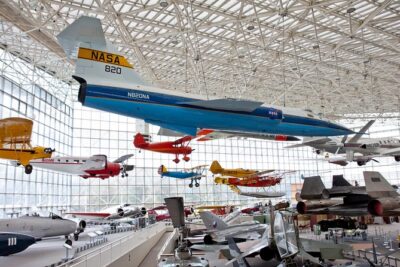
The Museum of Flight puts a remarkable amount of aviation under one roof, from a full-sized NASA Space Shuttle Trainer to a Boeing 747 cockpit you can enter. You’ll move through five galleries across a two-sided campus, with more than 150 aircraft, spacecraft, warplanes, and hands-on displays.
I especially like the soaring Great Gallery, where aircraft hang above you, and the Personal Courage Wing, which tells wartime stories through pilots, nurses, photographers, and ground crews. The main drawback is simple: this is not a quick museum stop. You need at least three hours, and aviation fans could easily spend most of a day here.
In This Review
- Key points to know before you go
- Why this Seattle museum deserves half a day
- Start with the Aviation Pavilion
- Walk beneath the Great Gallery aircraft
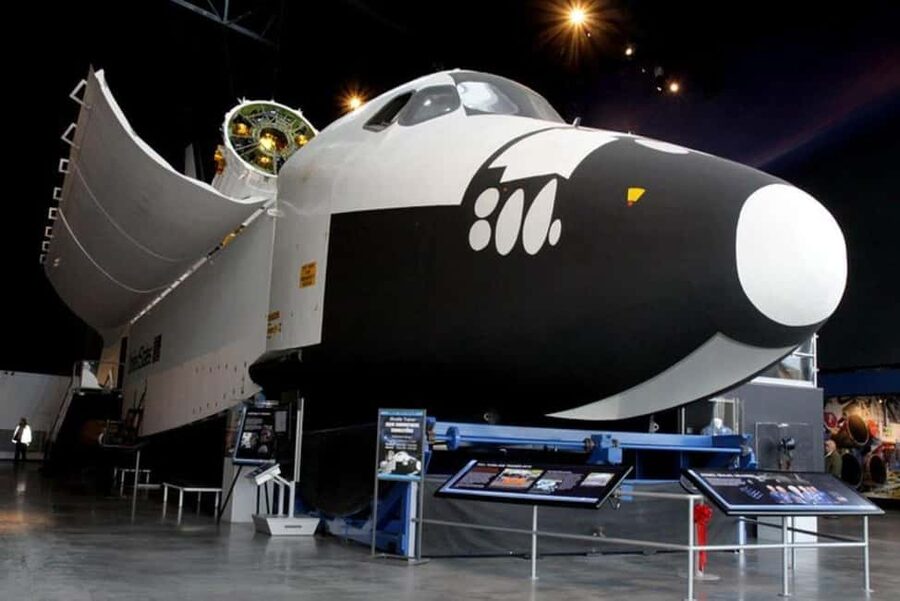
- Meet the Space Shuttle Trainer
- Step into the Personal Courage Wing
- See Cold War spy planes and combat jets
- Try the cockpits and hands-on exhibits
- Take the bridge for airport and Mount Rainier views
- Plan at least three hours, and preferably more
- What the $29 ticket includes
- Who should book the Museum of Flight
- Should you book it?
- FAQ
- How long should I spend at the Museum of Flight?
- What does the entry ticket include?
- Are the flight simulators included?
- Is the 3D flight movie included?
- What languages are available for the audio guide?
- What time is the last admission?
- Is the museum wheelchair accessible?
Key points to know before you go
- More than 150 aircraft: See historic passenger planes, fighters, spacecraft, experimental aircraft, and the rare M-21 Blackbird spy plane.
- A full day of aviation: Five galleries spread across a large two-sided campus make comfortable shoes and a sensible route worth planning.
- Hands-on family appeal: Cockpit access, interactive exhibits, flight simulators, and family activities keep this from feeling like a display-only museum.
- The Space Shuttle Trainer: The full-scale NASA training vehicle gives you a close look at the hardware astronauts used while preparing for missions.
- Extra-cost add-ons: The 3D flight film and flight simulators are not included in the $29 entry price.
- Useful practical details: Last admission is at 4 PM, the museum closes at 5 PM, and advance booking lets you skip the ticket line.
Why this Seattle museum deserves half a day
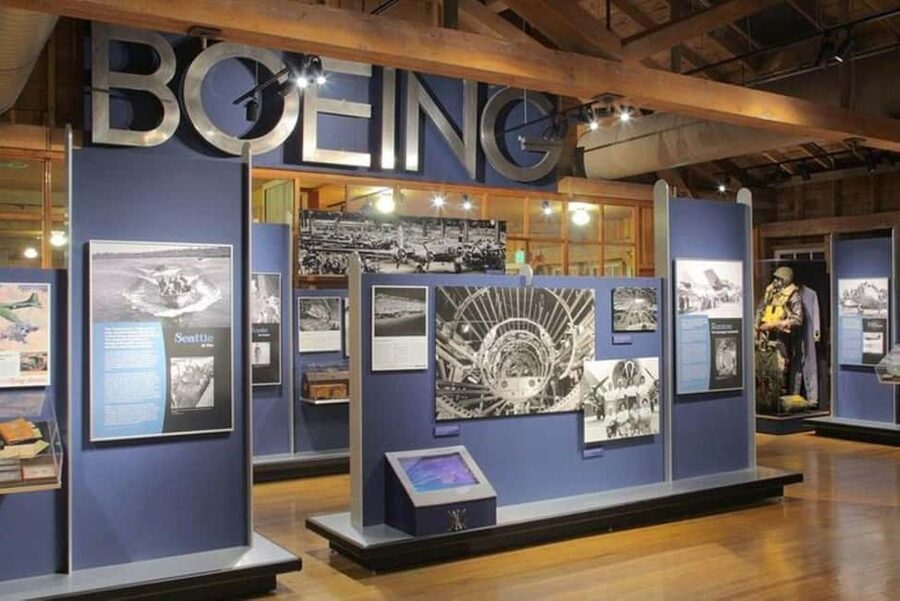
At $29 per person, the Museum of Flight is priced like a major attraction, but you get a full day of access rather than a short timed exhibit. The value improves if you care about aircraft, space exploration, military history, engineering, or family activities.
I would not treat this as a filler stop between other Seattle sights. The museum is very large, and its five galleries occupy both sides of a broad campus. You can see the main highlights in three hours, but that pace leaves little time for reading panels, trying activities, or returning to the aircraft that catch your eye.
The museum works for several kinds of visitors. A dedicated aviation fan can study rare aircraft and restored machines. A parent can use the cockpits, interactive displays, and simulators to keep younger children interested. You can also enjoy it without knowing much about aviation because the galleries connect machines to war, exploration, commercial travel, and individual courage.
More Seattle attraction tickets:
- Seattle: Space Needle & Chihuly Garden and Glass Ticket
★ 4.7 · 1,890 reviews - Space Needle and Chihuly Garden and Glass Combination Ticket
★ 4.5 · 1,551 reviews - Seattle CityPASS®: Save up to 46% at 5 Top Attractions
★ 4.6 · 742 reviews
Start with the Aviation Pavilion
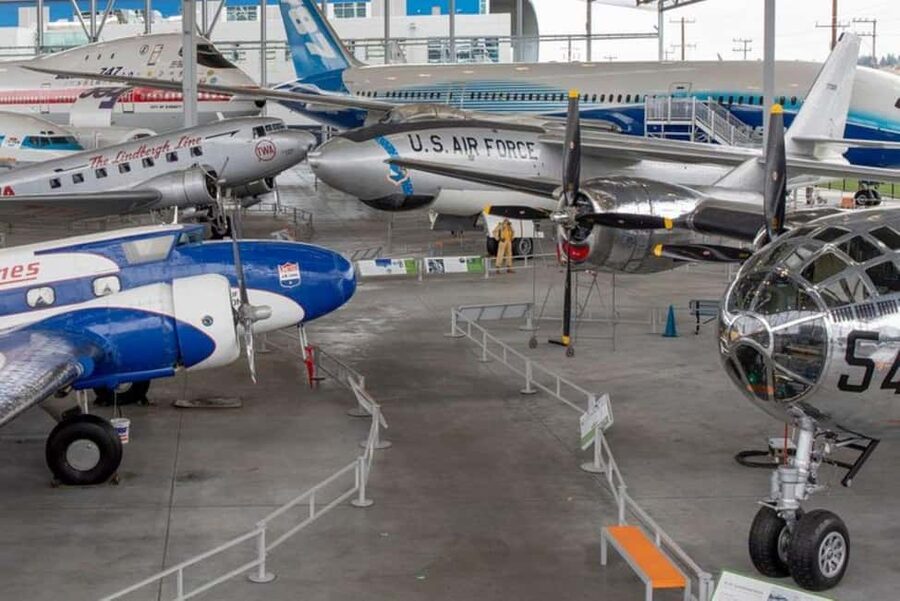
The Aviation Pavilion is a good first stop because its scale gives you an immediate sense of what this museum does well. Large aircraft are displayed in a glass-covered space, including the first flight-worthy Boeing 747.
That 747 is more than a familiar jumbo jet. It represents the moment commercial aviation began carrying large numbers of people across oceans at a new scale. If you have flown on a 747, the size feels familiar. If you have not, the aircraft helps explain why it changed air travel.
Look for the human-powered MacCready Gossamer Albatross II in the large glass gallery. It is a sharp contrast to the 747. One machine depends on enormous engines and heavy construction, while the other shows how light, careful design can turn human muscle into flight.
You can also see a replica of Amelia Earhart’s aircraft. The replica gives the display an important human connection, especially when placed beside the larger story of early aviation and long-distance flight. The museum does not present flight only as a series of technical achievements. It also shows the risks taken by the people who pushed aircraft into new territory.
Walk beneath the Great Gallery aircraft
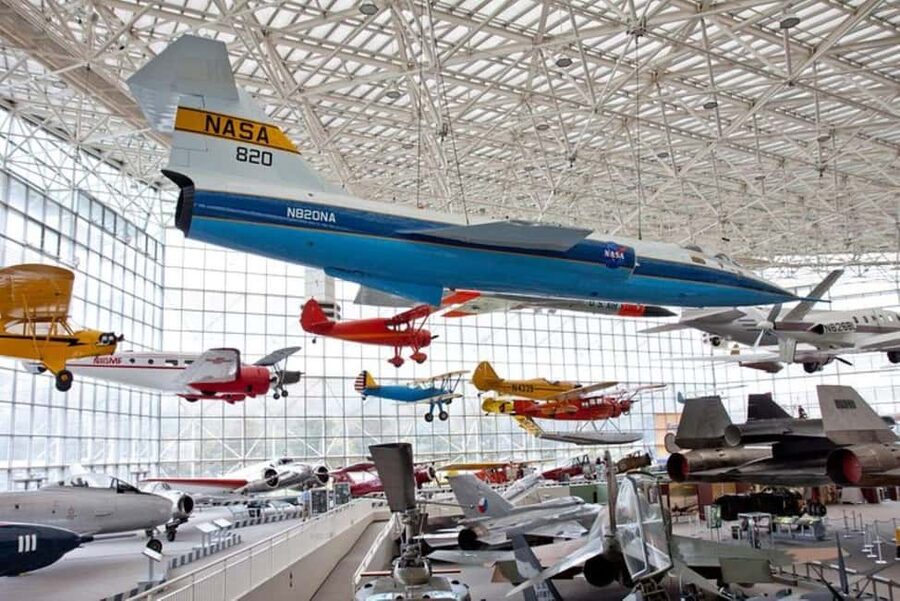
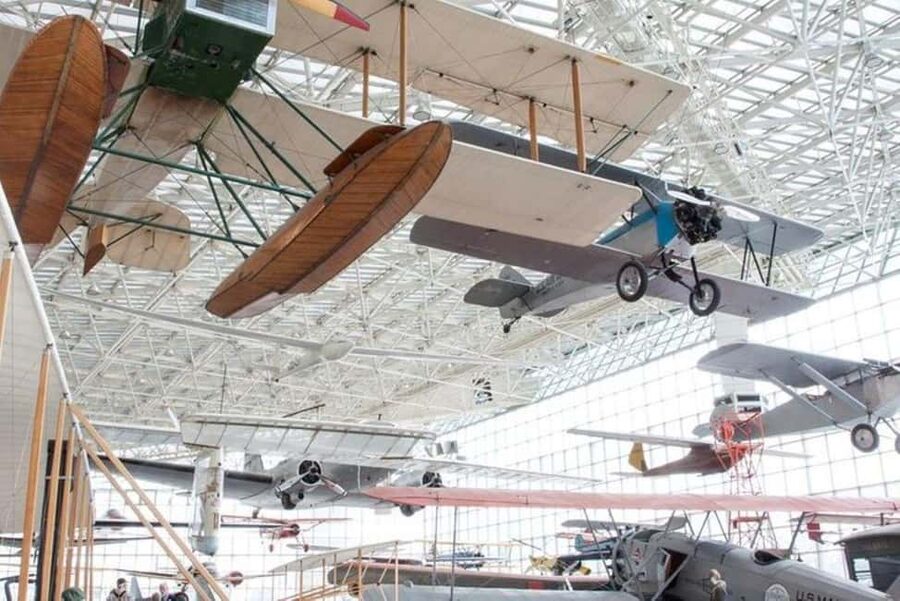
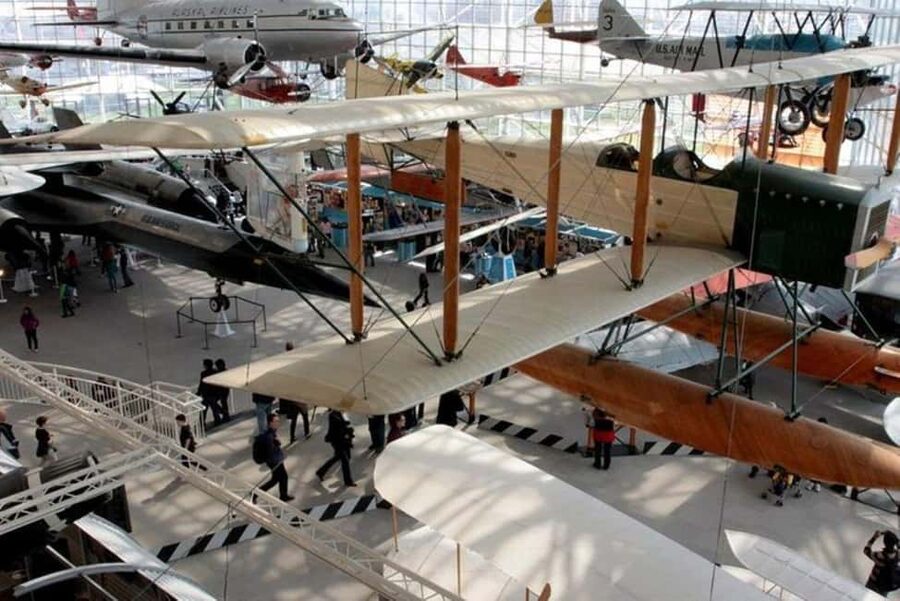
The Great Gallery is one of the most memorable rooms in the museum. Aircraft hang overhead in a soaring space, giving you changing views as you walk below them.
I like this area because the planes are not presented as flat objects behind glass. You can see their undersides, wings, landing gear, and unusual shapes from several angles. That matters with aircraft. A photo rarely conveys how large a plane is, how thin a wing can be, or how much machinery is packed into the body.
Give yourself time here instead of rushing from one aircraft to the next. Some displays will appeal to specialists, while others work simply as dramatic pieces of design. The Great Gallery is also a useful place to reset between the more story-driven sections of the museum.
The large open room can make the collection feel less crowded than a tightly packed exhibit hall. Still, the sheer size of the campus means you should keep track of where you are. The museum spans both sides of the campus, so moving through it takes more time than the exhibit labels alone suggest.
Meet the Space Shuttle Trainer
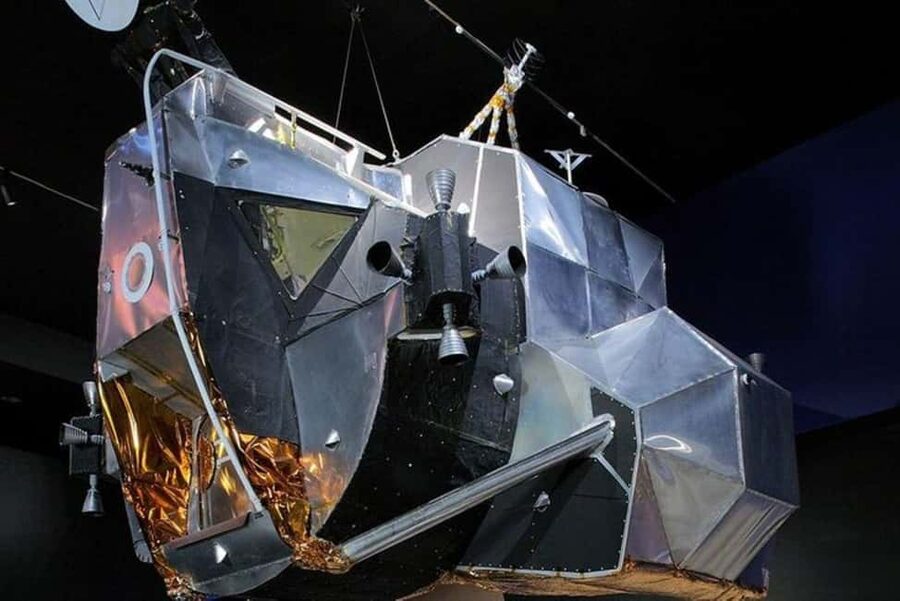
The Space Gallery shifts the focus from flight in the atmosphere to human travel beyond it. Its centerpiece is a full-scale NASA Space Shuttle Trainer used for astronaut preparation.
You will not be looking at a small model. The full-sized trainer gives you a sense of the shuttle’s working scale and the practical demands of astronaut training. It is one of the strongest reasons to visit even if your interests lean more toward space than historic airplanes.
The surrounding gallery uses multi-sensory displays to explain spaceflight and the technology behind it. I find this section valuable because it connects the polished image of space travel with the physical machines, procedures, and preparation required to make missions possible.
For families, the Space Gallery can provide a natural focus point. Children often respond well to the size of the shuttle trainer, while adults can spend more time considering how training turns a complex vehicle into something astronauts can operate under pressure.
More museums in Seattle:
- The Museum of Flight Entrance Ticket
★ 5.0 · 477 reviews - Seattle: Seattle Art Museum Admission Ticket
★ 4.8 · 67 reviews - Museum of Illusions Seattle Admission Ticket
★ 4.0 · 9 reviews - Seattle: National Nordic Museum Entry Ticket
★ 4.3 · 6 reviews
Step into the Personal Courage Wing
The Personal Courage Wing covers both World Wars through the experiences of people who made aviation possible. The focus includes pilots, nurses, photographers, and support crews, not only the famous names in the cockpit.
That wider view gives the gallery its weight. Warplanes can be exciting to look at, but the personal stories explain what those aircraft meant in real life. You get a better sense of the human cost, the work behind each mission, and the many roles required to keep an air force operating.
I recommend slowing down here. The aircraft may draw you into the room, but the accounts from medical staff, photographers, and ground crews give the displays meaning. This is also one of the better areas for adults who want more than machinery.
The presentation covers two major wars, so the gallery can feel serious compared with the lighter, hands-on sections. That is part of its value. The museum gives you room for wonder, but it also asks you to think about how aviation changed warfare and ordinary lives.
See Cold War spy planes and combat jets
The collection includes a rare M-21 Blackbird spy plane, along with jet fighters from the Korean and Vietnam Wars. These aircraft show how quickly military aviation changed after World War II.
The M-21 is especially useful for understanding the limits engineers were trying to overcome. Speed, altitude, surveillance, and extreme operating conditions all shaped the aircraft’s design. Its presence adds something uncommon to the museum because it represents intelligence gathering rather than a standard fighter role.
The Korean and Vietnam War jets place those technical changes in a broader timeline. You can compare their forms, missions, and eras as you move through the displays. Even without technical expertise, you will notice how quickly aircraft became faster and more specialized.
This part of the collection will appeal most to visitors interested in military history. If you prefer passenger aviation or space, it is still worth seeing, but you may spend less time here than in the Great Gallery or Space Gallery.
Try the cockpits and hands-on exhibits
The museum is not built only for looking. Hands-on exhibits and cockpit access make the visit more active, particularly for families and visitors who enjoy learning by trying things.
One of the best-known opportunities is sitting in a Boeing 747 cockpit. The cockpit gives you a practical sense of the pilot’s working environment, with its concentration of controls and instruments. It is more memorable than simply viewing the aircraft from the aisle.
Flight simulators are also available, but they require a separate ticket. That extra cost is worth considering before you arrive. If your main goal is seeing the collection, you can have a strong visit without them. If you want a more active aviation experience, the simulator may be a good add-on.
The same rule applies to the optional 3D flight film. It can provide a good opening to the subject and set the mood for the museum, but it is not part of the $29 admission. Check the additional price before committing, especially if you are visiting with several people.
Take the bridge for airport and Mount Rainier views
On a clear day, make time for the T. Evans Wyckoff Memorial Bridge. It offers views toward Seattle-Tacoma International Airport and Mount Rainier.
The bridge adds a useful outdoor pause to a museum visit that otherwise keeps you inside. You can watch aircraft operating at a real airport, then look toward Mount Rainier when visibility allows. The view depends on weather, so consider it a bonus rather than a guaranteed highlight.
I would save the bridge for a point when you need a break, or visit it near the end of your route. It helps connect the museum’s historic aircraft with the working aviation world outside. On a cloudy day, the airport view remains useful, but Mount Rainier may not appear.
Plan at least three hours, and preferably more
The museum recommends allowing at least three hours to see most of the collection. I agree with that as a minimum, not a target for a relaxed visit.
A three-hour route should focus on the Aviation Pavilion, Great Gallery, Space Gallery, and Personal Courage Wing, with time for the most important aircraft in the military collection. Add extra time for cockpit access, hands-on activities, the bridge, or the optional film.
A full day works best if you want to read detailed panels and try the interactive features. The museum’s one-day validity gives you room to set your own pace, but the provided ticket is an entrance ticket rather than a guided tour with a planned sequence.
The audio guide is included and available in English, German, Chinese, Russian, Japanese, French, and Spanish. That is useful in a museum with such a wide range of subjects. You can choose how much explanation you want instead of relying only on written displays.
Wear comfortable shoes. The campus is large, the galleries are spread across two sides, and moving between major sections takes time. If you arrive late in the day, remember that last admission is at 4 PM, one hour before the 5 PM closing time.
What the $29 ticket includes
The $29 admission covers entry to the museum and its main exhibits. That includes the aircraft collection, the galleries, the Space Shuttle Trainer, interactive displays, and access to the museum during the valid day.
It does not include flight simulators or the optional 3D movie. This makes the base ticket fairly clear, but your final cost can rise if you add both paid extras. I would first see how much time and energy your group has before buying additional activities.
The price feels strongest for visitors who will spend several hours inside. A quick one-hour visit is unlikely to deliver the same value because you will see only a small part of the campus. For a family or aviation enthusiast planning half a day or more, the admission gives you a substantial amount to explore.
Advance purchase can help you skip the ticket line. Flexible booking is also available, with cancellation up to 24 hours before the visit for a full refund and a reserve-now, pay-later option. Wheelchair access is available. Weapons and sharp objects are not allowed.
Who should book the Museum of Flight
I would recommend this experience first to anyone interested in aircraft, engineering, military history, space travel, or the story of commercial flight. It is also a strong choice for families because the collection includes interactive features rather than relying entirely on reading.
The museum suits curious visitors who like variety. You can move from a human-powered aircraft to a jumbo jet, then from wartime aircraft to a spacecraft trainer. That range keeps the day from becoming a single-subject display.
You should think twice if you have only a short window in Seattle or if large museums tire you quickly. The campus is expansive, and the museum rewards patience. You may also find the military galleries more serious than expected, especially in the Personal Courage Wing.
Staff service appears to be a strength. When a delayed transfer caused one visitor to arrive an hour late, the visit was extended by an hour, a practical bit of flexibility that matters when timing goes wrong. Still, you should plan to arrive with enough time rather than count on an extension.
Should you book it?
Book the Museum of Flight if you can give it at least three hours, and especially if you can spare half a day. The Space Shuttle Trainer, Boeing 747 cockpit, Great Gallery, rare M-21 Blackbird, and Personal Courage Wing provide enough variety to justify the admission.
I would skip the paid simulator and 3D film unless those extras match your group’s interests. The main ticket already offers the strongest part of the experience: an unusually large collection presented across several distinct galleries.
For a rainy Seattle day, a family outing, or a serious aviation stop, this is a very good use of your time. Just arrive early enough to avoid racing through the final gallery before the 4 PM last admission.
FAQ
How long should I spend at the Museum of Flight?
Plan on at least three hours to see most of the exhibits. The museum is large, with five galleries spread across a two-sided campus, so aviation enthusiasts may want to spend most of the day.
What does the entry ticket include?
The ticket includes admission to the Museum of Flight and its main galleries and exhibits for one day.
Are the flight simulators included?
No. Tickets for the flight simulators cost extra.
Is the 3D flight movie included?
No. The 3D movie is optional and requires a separate payment.
What languages are available for the audio guide?
The audio guide is available in English, German, Chinese, Russian, Japanese, French, and Spanish.
What time is the last admission?
Last admission is at 4 PM. The museum closes at 5 PM.
Is the museum wheelchair accessible?
Yes. The Museum of Flight is wheelchair accessible.
Just added around Seattle
- Native Culture – Suquamish and Chief Seattle★ 5.0 · 3 reviews
- Break It and Make It: A Glass Fusing Session in Everett★ 4.5 · 3 reviews
- Bainbridge Island Discovery and Wine Tour★ 5.0 · 3 reviews
- Seattle: Twilight Tour and Olympic National Park★ 5.0 · 3 reviews
- Beaches, Bites and Bavaria in Leavenworth: A Self-Guided Audio Tour★ 3.5 · 3 reviews
- Seattle: Lake Union Happy Hour Cruise★ 3.7 · 3 reviews
- Seattle: Lake Union Kayak Tour – Small Groups, Big Views★ 5.0 · 3 reviews
- Sail Bainbridge Island & Seattle Waters – Classic Sailboat★ 5.0 · 3 reviews