Reviewed · MUSEUMS
Museum of Illusions Seattle Admission Ticket
The Museum of Illusions Seattle turns a simple afternoon into a series of visual tricks. You can appear to defy gravity, change your apparent size, walk into a life-size kaleidoscope, and watch holograms play with the way your brain reads the world. The point is not just to fool you, but to show how perception works.
I like the hands-on format, since you are not merely staring at glass cases. I also like the mix of playful photo setups and science-based explanations, which gives families and curious adults something to discuss as they move from room to room. The main caution is value: at $41 per person, the experience may feel brief if you move quickly or only find a few exhibits that hold your attention.
In This Review
- Key points to know
- What the Museum of Illusions Seattle actually offers
- Beginning with more than 50 visual tricks
- The illusion rooms: where the fun becomes physical
- Holograms and installations that explain perception
- The life-size kaleidoscope and changing viewpoints
- How long should you allow?
- Is $41 a fair price?
- Who will enjoy this most?
- Practical details that affect your visit
- How to get more from each exhibit
- Should you book the Museum of Illusions Seattle?
- FAQ
- How much does admission to the Museum of Illusions Seattle cost?
- How long does the experience last?
- What is included with admission?
- Can I use a mobile ticket?
- Will I receive booking confirmation right away?
- Is the museum near public transportation?
- Are service animals allowed?
- Can I cancel or change my ticket?
Key points to know
- More than 50 exhibits: Expect illusion rooms, installations, holograms, and interactive displays rather than a traditional collection of objects.
- A short, flexible visit: The stated visit can range from about 1 minute to 1 hour 30 minutes, so your pace matters.
- Built around perception: The displays show how your eyes and brain can interpret the same scene in surprising ways.
- Good for hands-on fun: You can take part in visual tricks involving size, gravity, mirrors, and changing viewpoints.
- $41 requires a full visit: The ticket makes the most sense if you take time with the explanations and try many exhibits.
- Easy basic access: You receive confirmation at booking, use a mobile ticket, and the museum is near public transportation.
What the Museum of Illusions Seattle actually offers

This is not a conventional museum with long written panels and precious objects behind ropes. It is a playfully arranged series of rooms and installations designed to make you question what your eyes are telling you.
The central idea is simple: your brain builds your sense of reality from visual information, but that process is not perfect. The museum uses that weakness in entertaining ways. A room may make your body appear larger or smaller. An installation may make gravity seem to work in the wrong direction. A hologram may appear to shift as you change your position.
You are encouraged to take part rather than simply walk past. That matters because the best illusions often depend on where you stand, what you look at, or how another person appears in the frame. If you arrive with a friend or family member, you can take turns trying the setup and photographing the result.
More Seattle attraction tickets:
- Seattle: Space Needle & Chihuly Garden and Glass Ticket
★ 4.7 · 1,890 reviews - Space Needle and Chihuly Garden and Glass Combination Ticket
★ 4.5 · 1,551 reviews - Seattle CityPASS®: Save up to 46% at 5 Top Attractions
★ 4.6 · 742 reviews
Beginning with more than 50 visual tricks
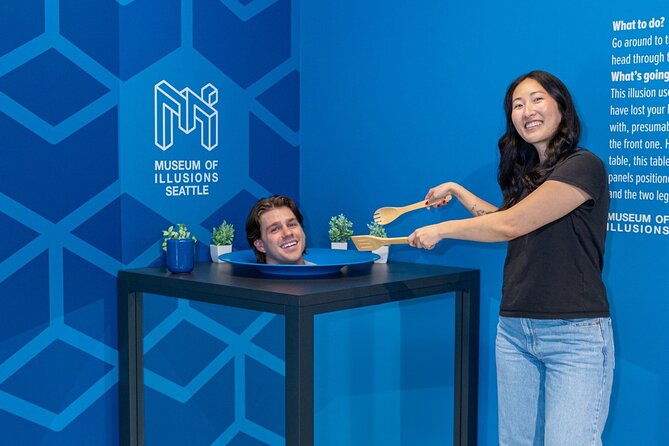
The museum offers over 50 exhibits, so the visit has more variety than a single optical illusion or photo room. You might move from a display that plays with perspective to one that challenges your sense of balance, then pause at a hologram that changes as you look at it from another angle.
The number sounds generous, but it needs context. Fifty exhibits do not mean 50 lengthy activities. Many are quick to understand and enjoy. You may grasp the trick within seconds, then spend a little longer testing it or taking a picture. Your total time depends heavily on how carefully you read, how many exhibits interest you, and how much time you spend with each illusion.
That is why the official visit range stretches from about 1 minute to 1 hour 30 minutes. The lower end is not a realistic sightseeing plan, but it signals that this is a compact attraction rather than a half-day museum. For most people, the value comes from trying the displays instead of racing through them.
The illusion rooms: where the fun becomes physical
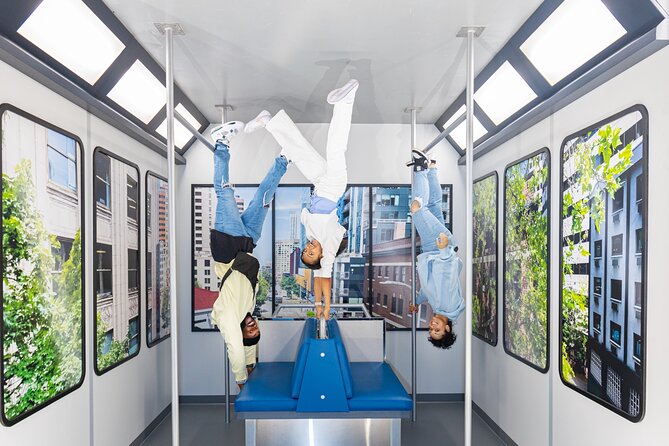
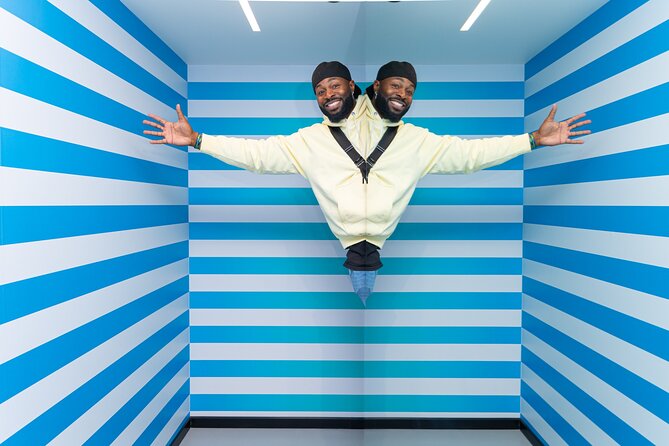
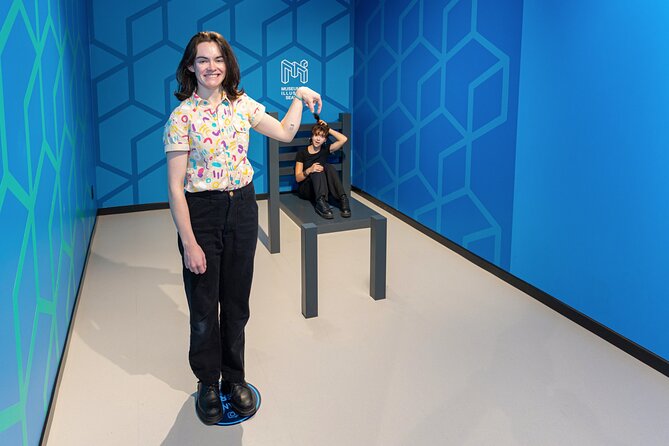
The illusion rooms are likely to be the most memorable part of the visit because they change your sense of scale, balance, or position. You might appear to grow or shrink, or find yourself in a setting that makes ordinary movement look strange.
These rooms work best when you interact with them. Stand in the suggested spot, look through the intended angle, and let someone else see the effect from outside. If you simply glance in and move on, the exhibit can seem like a basic room decoration. Give it a moment and the trick becomes easier to understand.
The physical nature of these displays makes them especially suitable for families and groups. Children can see the effect right away, while adults may enjoy figuring out the visual mechanics behind it. The experience also gives you a natural reason to take photos, though the value of the visit should not depend only on getting a good picture.
Holograms and installations that explain perception
The holograms add a different kind of illusion. Instead of changing your apparent position or body size, they challenge the way an image seems to occupy space. As you look, the display can appear more solid or more dimensional than it really is.
The educational side of the museum is important here. These effects are not presented as supernatural events. They are examples of how the brain interprets light, depth, shape, and movement. You get a bit of visual entertainment, but you also leave with a clearer sense that seeing is an active process.
That mix is one of the better reasons to choose this attraction over a purely decorative photo stop. You can enjoy the odd image first, then think about why it fooled you. The explanations may be brief, but they give the displays a purpose beyond quick amusement.
More museums in Seattle:
- The Museum of Flight Entrance Ticket
★ 5.0 · 477 reviews - Seattle: Seattle Art Museum Admission Ticket
★ 4.8 · 67 reviews - Seattle: The Museum of Flight Entry Ticket
★ 4.6 · 24 reviews - Seattle: National Nordic Museum Entry Ticket
★ 4.3 · 6 reviews
The life-size kaleidoscope and changing viewpoints
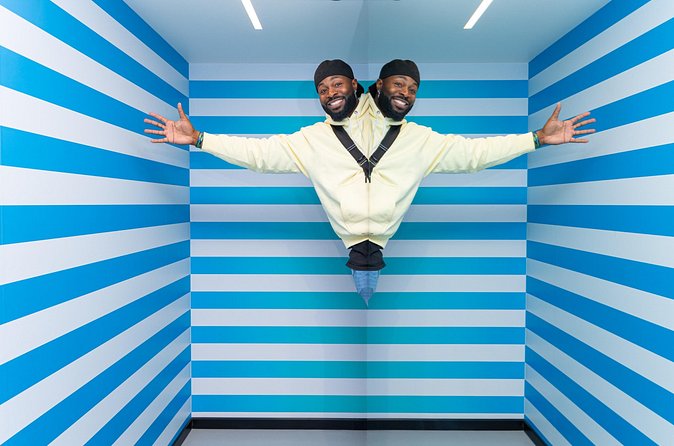
A life-size kaleidoscope is among the more distinctive features. A normal kaleidoscope is something you hold in your hand. Here, you step into the effect, surrounded by shifting patterns and repeated shapes.
The appeal is easy to understand, but the experience remains dependent on your expectations. It is a visual installation, not a long performance or guided show. You enter, look around, and decide how much time you want to spend noticing the patterns.
The museum’s other installations work in much the same way. They are designed to produce a quick mental jolt, then invite you to work out what happened. You may find yourself checking the same display from another angle because the first view does not explain the result.
How long should you allow?

You should plan on up to 90 minutes if you want to try the exhibits at a relaxed pace. That gives you time to stop at the displays that interest you, read the educational material, and repeat a few effects with a companion.
A faster visit is possible. If you are mainly interested in taking a few pictures, you could move through much sooner. That flexibility can be useful on a busy Seattle day, especially if you are fitting the museum between other plans.
Still, the short length creates the biggest value question. A $41 admission ticket is easier to justify when you stay close to the full 90 minutes. If you finish in a much shorter time, the cost per hour rises quickly. Before booking, ask yourself if you enjoy testing several versions of the same visual idea, not just seeing one or two striking rooms.
Is $41 a fair price?
At $41 per person, this is not a bargain attraction. The ticket is best viewed as payment for a compact, interactive experience in which the exhibits provide the activity and the explanation.
I see two ways to judge the price. If you enjoy optical illusions, unusual photographs, and hands-on displays, the variety of more than 50 exhibits can make the admission reasonable. You are getting a complete attraction rather than paying for a single room or one short demonstration.
If you prefer large museums, long tours, or a packed schedule of substantial activities, you may find the price high. The experience can feel short, especially if only a handful of exhibits appeal to you. One critical assessment described the attraction as offering too few activities for the cost, and another found only a few displays especially interesting. Those are fair concerns, not minor complaints.
I would book it as a focused stop, not as the main event of your Seattle day. The price makes more sense when the museum matches your interests and you are prepared to take your time.
Who will enjoy this most?
The museum suits families, couples, groups of friends, and adults who like puzzles involving sight and perception. You do not need specialist knowledge. Most people can take part, and the exhibits are designed to be understood through direct interaction.
It also works for mixed-age groups. A child may enjoy appearing to shrink, while an adult may prefer the explanation of why the trick works. Since the displays are visual and physical, you can choose the level of detail that suits you.
I would be more cautious if you dislike photo-oriented attractions or want a serious art collection. The museum is educational, but its lessons are tied to playful visual effects. It is not meant to replace a major science museum or a long historical museum visit.
Practical details that affect your visit

You receive confirmation at the time of booking, and the ticket is mobile, so you can keep it on your phone. The museum is near public transportation, which makes it easier to include without needing a car.
Service animals are allowed, and most people can participate. The available information does not give a detailed accessibility breakdown for every exhibit, so if you need specific accommodations, contact the provider before paying.
The experience requires good weather. If poor weather causes cancellation, you are offered another date or a full refund. Your own ticket is otherwise non-refundable and cannot be changed for any reason, so choose your date carefully before booking.
Because the attraction is indoors but the booking carries this weather condition, check the terms closely. Do not assume you can simply shift the time later if your plans change.
How to get more from each exhibit
Start slowly. The first few illusions show you how the museum works, and they may help you understand how much time you want to spend at each display.
Look for the intended viewpoint. Many optical tricks depend on perspective, so standing in the wrong place can make a good exhibit seem ordinary. Follow the markings or instructions, then move around and see how the effect changes.
Use a companion when possible. One person can take part while the other watches the full visual effect. Then switch places. This is particularly useful for the rooms involving apparent size, gravity, or altered perspective.
Read the explanations. The scientific notes are part of the admission, not an optional extra. They help turn a quick photo into a small lesson about how your brain processes visual information.
Finally, do not judge the entire museum by its first display. The collection includes different types of illusions, from rooms to holograms to installations. If one trick does little for you, move on rather than deciding too quickly.
Should you book the Museum of Illusions Seattle?
Book it if you want a compact, hands-on attraction with more than 50 visual tricks and you enjoy taking part in the display. It is a sensible choice for families and groups looking for something playful, easy to understand, and different from a standard museum.
Think twice if $41 feels high for up to 90 minutes or if you expect every exhibit to be a major activity. The museum’s strongest feature is its variety, but the visit can feel thin when you move quickly or connect with only a few illusions.
My practical advice is simple: book when the science of perception and interactive photo setups sound like the main point of your day, not when you are searching for a long museum visit. Arrive ready to test each display, read the explanations, and spend enough time with the collection to make the admission work for you.
FAQ
How much does admission to the Museum of Illusions Seattle cost?
Admission costs $41 per person.
How long does the experience last?
The stated duration ranges from about 1 minute to 1 hour 30 minutes. Your visit length depends on how quickly you move through the exhibits and how much time you spend with them.
What is included with admission?
Admission includes entry to the Museum of Illusions Seattle and its more than 50 illusion rooms, installations, holograms, and hands-on exhibits.
Can I use a mobile ticket?
Yes. A mobile ticket is available for this experience.
Will I receive booking confirmation right away?
Confirmation is received at the time of booking.
Is the museum near public transportation?
Yes. The museum is near public transportation.
Are service animals allowed?
Yes. Service animals are allowed.
Can I cancel or change my ticket?
The ticket is non-refundable and cannot be changed for any reason. If poor weather causes the experience to be canceled, you will be offered a different date or a full refund.
Just added around Seattle
- Native Culture – Suquamish and Chief Seattle★ 5.0 · 3 reviews
- Break It and Make It: A Glass Fusing Session in Everett★ 4.5 · 3 reviews
- Bainbridge Island Discovery and Wine Tour★ 5.0 · 3 reviews
- Seattle: Twilight Tour and Olympic National Park★ 5.0 · 3 reviews
- Beaches, Bites and Bavaria in Leavenworth: A Self-Guided Audio Tour★ 3.5 · 3 reviews
- Seattle: Lake Union Happy Hour Cruise★ 3.7 · 3 reviews
- Seattle: Lake Union Kayak Tour – Small Groups, Big Views★ 5.0 · 3 reviews
- Sail Bainbridge Island & Seattle Waters – Classic Sailboat★ 5.0 · 3 reviews